
How Far Apart Should Fence Posts Be? A Structural Guide
A beautiful fence can completely transform your yard in Raymore, MO. It adds value, provides security, and gives your family a private space to enjoy. However, a fence is only as strong as its structural skeleton. If your fence posts are placed too far apart, the entire structure will sag, twist, or fall over when the first heavy Missouri wind storm rolls through.
Knowing exactly how far apart to space your fence posts is one of the most critical parts of planning your installation. In this guide, we will break down the ideal post spacing requirements by material, outline the top factors to consider, and show you how to map out your yard like a pro.
Why Fence Post Spacing is Important
The distance between your fence posts directly impacts the structural integrity of your entire barrier. Getting this measurement right is vital for several key reasons:
- Preventing Rail Sag: Fencing materials are heavy. If the distance between support posts is too wide, gravity will pull the horizontal rails down over time, causing them to bow or sag in the middle.
- Resisting Wind Loads: A privacy fence acts like a giant sail. Properly spaced posts transfer the immense wind pressure safely into the ground, ensuring your fence remains stable during severe weather.
- Ensuring Code Compliance: Many cities and Homeowners Associations have strict regulations regarding structural stability. Sticking to standard spacing guidelines ensures your project passes any local inspections.
- Saving Money on Materials: While placing posts closer together makes a fence stronger, spacing them too closely can add unnecessary material and labor costs to your project. Finding the right balance keeps your project budget-friendly and durable.
Considerations for Fence Post Spacing
Determining the perfect post layout requires looking at a few unique environmental and design factors:
The Weight of the Material
Heavy wood or vinyl panels require closer spacing than lightweight decorative aluminum.
Local Wind Exposure
If your property sits on an open lot in Lee’s Summit with little wind protection, you should reduce your post spacing slightly to add structural rigidity.
The Slopes in Your Yard
If your yard has hills or dips, the post spacing must be adjusted to accommodate stepping or racking techniques, which often requires shorter spans to keep the bottom gaps closed.
Gate Placements
Gates experience constant movement and vibration. The posts flanking a gate must be set precisely and often require custom spacing to accommodate the gate hardware.
Fence Post Spacing by Material
Different fencing materials are manufactured to different standards. Here is the ideal post spacing for the most common materials used in our area.
Wood Fencing
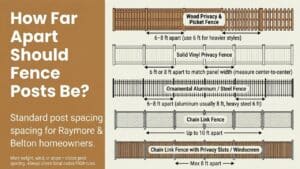
For standard wood privacy and picket fences, the industry standard is to space posts 6 to 8 feet apart. An 8-foot spacing is the most common because horizontal 2×4 rails are sold in standard 8-foot lengths. If you are building a heavy wood fence, such as a board-on-board privacy style, dropping the spacing to 6 feet provides extra support to prevent the horizontal rails from sagging under the weight of the overlapping pickets.
Vinyl Fencing
Most high-quality vinyl fences are sold as pre-fabricated panels that are 6 feet or 8 feet wide. Because vinyl panels cannot be stretched or trimmed like wood, your post spacing must match the exact width of the panel you choose. For a 6-foot panel, your posts must be set exactly 6 feet apart, measured center-to-center.
Ornamental Aluminum and Steel Fencing
Ornamental metal fences are typically sold in pre-assembled sections that are 6 feet or 8 feet wide. Because aluminum is lightweight and allows wind to pass through freely, an 8-foot post spacing is standard and highly stable. Steel fences are heavier and may require a 6-foot spacing depending on the soil conditions and the height of the fence.
Chain Link Fencing
Chain link fences are incredibly durable and flexible. The standard post spacing for residential chain link is 10 feet apart. However, if you are planning to add heavy privacy slats or a windscreen to your chain link fence, you should reduce the spacing to 8 feet to help the posts handle the increased wind resistance.
Fence Post Spacing Chart
Here is a quick-reference guide to standard post spacing by material and typical residential heights:
| Material Type | Standard Post Spacing | Common Fence Height |
| Wood Privacy | 6 to 8 feet | 6 feet |
| Wood Picket | 6 to 8 feet | 3 to 4 feet |
| Solid Vinyl Privacy | 6 feet or 8 feet | 6 feet |
| Ornamental Aluminum | 6 feet or 8 feet | 4 to 5 feet |
| Chain Link (Standard) | 10 feet | 4 to 6 feet |
| Chain Link (with Privacy Slats) | 8 feet | 4 to 6 feet |
Common Fencing Post Spacing Mistakes and How to Avoid Them
Even minor calculation errors can cause massive headaches during a fence installation. Here are the most common mistakes DIYers make and how to avoid them:
Placing Posts Too Far Apart
This is the most common mistake. Spacing posts even a few inches past their recommended limit puts too much stress on the horizontal rails, leading to structural failure. Always round your measurements down and add an extra post if your total run length does not divide evenly.
Ignoring the True Panel Width
When using pre-fabricated vinyl or aluminum panels, you cannot guess the spacing. If a panel is advertised as 6 feet, the actual distance between your posts must be exactly 6 feet, minus the width of the post itself. Always buy your panels first and measure them physically before digging your holes.
Forgetting to Plan for Gates
Fence gates require wider clearances and experience more structural stress. Many DIYers space all their posts evenly and then realize their gate does not fit. Always determine your gate placement first, set those posts, and then space your remaining run posts outward from there.
Failing to Adjust for Slopes
If your yard slopes, standard horizontal measurements will not work. Measuring along the slope of a hill increases the physical distance between your posts. To keep your panels level, you must use a transit level or a string level to ensure your post spacing remains correct on the horizontal plane.
Step-by-Step Guide to Spacing Your Fence Posts
Ready to map out your yard? Follow this step-by-step layout guide to ensure your posts are perfectly aligned and spaced:
- Clear the Line: Clear any brush or debris along your planned fence line and consult with local utility companies to locate any underground lines before you dig.
- Set Your Corner and End Stakes: Drive wooden stakes into the ground at all corners, ends, and gate locations.
- Pull a Tight Guide Line: Tie a high-visibility mason’s line tightly between your corner stakes. This line represents the exact face of your fence and ensures your post line remains perfectly straight.
- Determine the Total Run Length: Measure the exact distance between your corner stakes along the guide line.
- Calculate Your Spacing: Divide the total run length by your desired panel width. For example, if your run is 50 feet and you are using 8-foot wood panels, 50 divided by 8 is 6.25. Since you cannot install a fraction of a post, you will round up to 7 sections. Divide your 50-foot run by 7 to get an even post spacing of approximately 7.14 feet, which is about 7 feet and 1 inch. This ensures all your sections look equal, rather than having six 8-foot sections and one awkward 2-foot section at the end.
- Mark Your Post Holes: Start from one corner post and measure along your guide line, marking the center of each post hole with spray paint.
DIY Spacing Challenges vs. Professional Precision
Calculating fence post spacing on paper is a straightforward math problem, but executing it in your yard is a physical and geometric challenge. If your measurements are off by even a tiny fraction, it can ruin the entire installation. Trusting a professional fence installation team ensures your fence is built with exact precision and offers several key advantages over the DIY route.
Compound Spacing Errors
If you are installing pre-fabricated panels like vinyl or aluminum, your post spacing must be exact. If you are off by just one inch on your first post, that error compounds with every subsequent post. By the time you reach the end of a run, your panels will not fit, forcing you to dig new holes or waste expensive materials.
Obstacles in the Soil
A diagram assumes perfect soil, but the ground in Missouri is rarely cooperative. When digging manually, hitting a tree root, a large rock, or heavy clay can force you to shift a post hole several inches to the side. A professional team has the heavy-duty machinery to push through these obstacles or safely calculate adjusted spacing on the fly without compromising the fence line.
The Sloped Terrain Challenge
Measuring along the slope of a hill increases the physical distance between your posts. If you do not account for the angle of the grade, your vertical posts will not align with your horizontal panels. Professionals use transit levels to calculate the slope and ensure the spacing remains correct on the horizontal plane.
Professional Fence Installation from Elite Fence
At Elite Fence, our family-owned team uses professional transit levels and heavy-duty augers to ensure every single post is set to the perfect depth and spaced with absolute precision. We handle all the utility locating, and heavy lifting so you can simply sit back and enjoy a flawless new boundary.
Ready to see how a professionally installed fence fits your budget? Use our Free Fence Estimator Tool on our website to virtually draw your layout and get an instant quote in minutes! We are the premier choice for professional fence installation in Lee’s Summit and serve as the most trusted fencing contractors in Raymore and Belton.
Contact Elite Fence today to schedule your consultation and ensure your fence is built on a rock-solid, perfectly spaced foundation!
Fence Post Spacing FAQ
How do I measure fence post spacing?
Fence post spacing is always measured “center-to-center.” This means you measure from the exact center of one post to the exact center of the next post, rather than measuring the clear gap between the inside edges of the wood. Measuring center-to-center ensures that your horizontal rails sit fully on the posts.
How do I calculate fence post spacing?
To calculate your spacing, measure the total length of your fence run and divide it by the standard length of your fence panels. If the number does not divide evenly, round up to the next whole number to find your total number of sections. Then, divide your total run length by that number of sections to find the exact, equal spacing for each post.
What is the post spacing for a chain link fence?
For standard residential chain link fences, the maximum post spacing is 10 feet. If you are adding heavy privacy slats or a fabric windscreen, you should reduce this spacing to 8 feet to ensure the posts can handle the increased wind resistance without leaning.