
How to Build a Fence on a Slope: DIY Guide vs. Professional Installation
Many properties in Raymore, MO, and the surrounding Kansas City area aren’t perfectly flat. While a sloped yard can add character to your landscape, it can make fencing projects feel a bit more daunting.
The good news is that with the right planning, you can build a sturdy fence that follows the natural grade of your land. However, before you pick up a shovel, it is important to understand the complexities of the job to decide if a DIY approach or a professional installation is right for your property.
Choosing Your Method: Racked vs. Stepped
When dealing with an incline, there are two primary ways to install fence panels. Your choice depends on the steepness of your slope and your skill level.
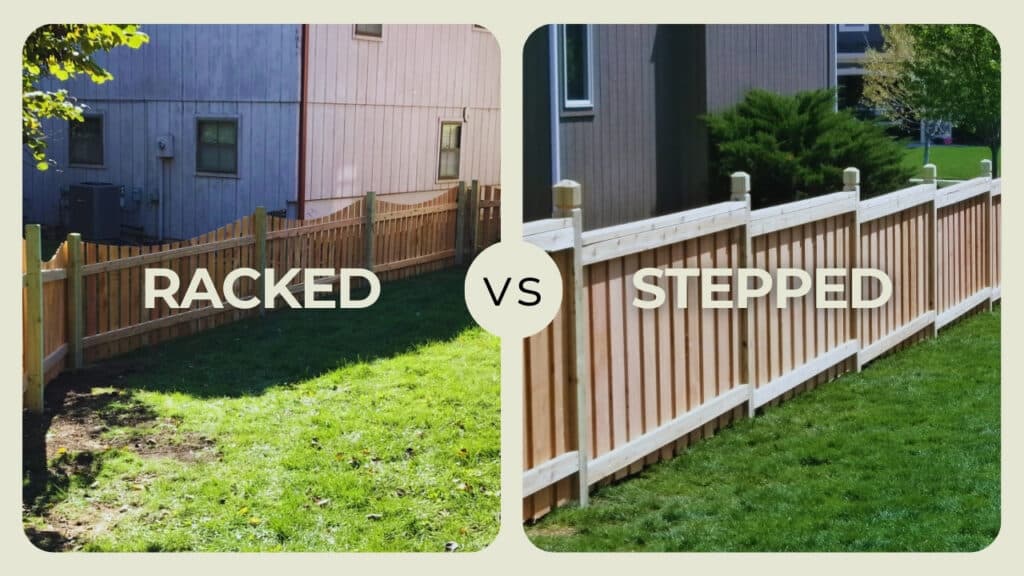
The Racked (Contoured) Method
In a racked installation, the fence panels are angled to follow the natural contour of the ground. The posts remain perfectly vertical (plumb), but the rails slant to stay parallel with the slope.
- Best for: Gentle to moderate slopes.
- DIY Challenge: High. Aligning pickets on a slant while keeping posts plumb requires precise measurement and often custom-cutting individual components.
The Stepped Method
The stepped method treats the fence like a staircase. Each panel is installed level, and the fence “steps down” at each post.
- Best for: Steep hills or pre-assembled panels.
- DIY Challenge: Moderate. While easier to visualize, calculating the exact “drop” per section is critical to prevent awkward heights or uneven steps.
How to Build a Horizontal Fence on a Slope
Horizontal fencing is a popular modern choice, but it is notoriously difficult on sloped ground. Because horizontal boards cannot “rake” like vertical pickets, you have two options:
- The Stepped Horizontal Look: Each section is level, but you stagger the height of the boards as you move down the hill.
- The Contoured Method: You scribe each horizontal board to match the angle of the terrain.
- Pro Tip: This is incredibly labor-intensive. It requires cutting the ends of every single board at the exact angle of your slope so they fit flush against your posts. This level of precision is where most DIY projects run into trouble.
Step-by-Step: How to Build a Fence on a Slope
If you are tackling this as a DIY project, follow these core steps:
- Calculate the Drop: Drive stakes at the top and bottom of the slope. Run a mason’s line between them and use a line level. Measure the vertical distance from the string to the ground at the bottom stake to find your “total drop.”
- Determine Post Spacing: Divide the total drop by the number of fence sections to find the “drop per section.”
- Set Your Posts: Dig holes 2 to 3 feet deep. Ensure every post is plumb, even if the ground is not. Note: On a slope, the downhill side of the post hole requires more concrete and depth to resist gravity’s pull over time.
- Install Rails/Panels: Start at the highest point and work down to maintain alignment.
DIY vs. Professional Installation: What’s Best for You?
While building a fence yourself can save on labor costs, sloped terrain introduces risks that can lead to long-term issues.
The DIY Approach
Deciding to handle the project yourself involves weighing the immediate financial savings against the technical demands of the terrain.
- Pros: Potential cost savings on labor; personal satisfaction.
- Cons: Extremely time-consuming; high risk of “bottom gaps” where pets can escape; potential for a leaning fence if posts aren’t anchored for gravity on a slope.
The Professional Advantage
Hiring experts ensures the job is done right the first time, addressing the structural and aesthetic complexities that sloped yards present.
- Precision Engineering: Professionals use specialized transit levels to calculate grades, ensuring a perfectly smooth transition that DIYers often struggle to replicate by eye.
- Structural Integrity: On a slope, soil erosion and gravity are constant threats. Fence installation professionals set posts deeper and use specific concrete techniques to ensure the fence doesn’t lean after the first heavy Missouri rain.
- Customization: A professional can custom-cut a horizontal fence to follow the grade perfectly. A task that can take an amateur days of frustration and wasted material.
Ready for a Professional Result?
Building on a slope is one of the most challenging fencing projects. If you want a perfectly level, high-quality result without the stress of complex geometry and heavy labor, let the experts at Elite Fence handle it.
We are a family-owned company based in Raymore, MO, specializing in the tricky terrain of the Kansas City area. We proudly serve homeowners in Lee’s Summit, Overland Park, Belton, and many more!
Curious about the cost? Use our online fence estimator tool to get a quote in minutes, or contact Elite Fence today to schedule a professional consultation!
Fencing FAQ
What is the steepest slope you can rack a fence on?
Most standard panels can handle a drop of about 1 foot over a 6-foot span. For anything steeper, a professional should evaluate if a custom-contoured install or a stepped install is safer.
How do I fill the gaps under a stepped fence? DIYers often use rocks or dirt, which can wash away. Professionals can install custom “kickboards” or “rot boards” that follow the ground level perfectly to close gaps for pets.
Will a fence on a slope be less stable? Not if it’s installed correctly! Professional installers account for the increased pressure on the downhill side of posts, ensuring the fence remains upright for decades.