
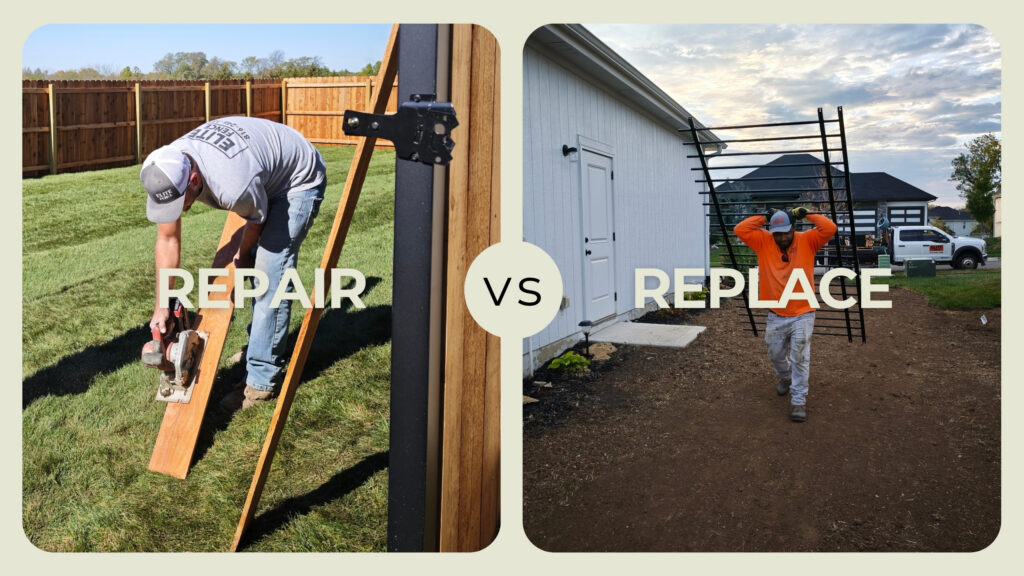
Should You Repair or Replace Your Fence? A Homeowner’s Guide
A sturdy, attractive fence defines your boundary, keeps children and pets secure, and provides essential privacy for your backyard. Over time, however, weather exposure, soil movement, and natural aging will cause wear and tear. When boards begin to crack or posts start to lean, homeowners face a common dilemma: should you repair the damaged sections or replace the entire fence?
Making the right choice depends on the extent of the damage, the overall age of the structure, and the cost difference between fixing individual parts and starting fresh. In this guide, we will break down the signs that point to simple repairs, the clear indicators that a full replacement is needed, and how to make the best financial decision for your property.
The 50 Percent Rule for Fence Evaluation
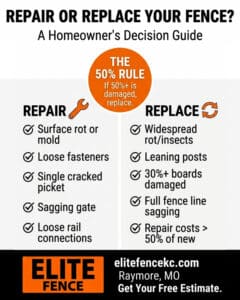
Before inspecting individual boards, a general rule of thumb can help guide your decision: The 50 Percent Rule.
If less than 20 to 30 percent of your fence is damaged and the structural posts remain solid, targeted repairs are almost always the most cost-effective choice. However, if more than 50 percent of the fence shows signs of rot, warping, or failure, repairing individual parts becomes a losing game. Patching up an old fence piece-by-piece often costs more over two or three years than installing a brand new system with a fresh warranty.
Signs Your Fence Needs Repair
When fence damage is isolated to a few pickets or minor hardware issues, simple repairs can restore structural safety and extend the life of your boundary by several years. Here are the primary signs that your fence only needs a professional repair.
Minor Surface Rot or Localized Surface Mold
If you notice small patches of surface mold, algae, or shallow rot on a couple of pickets, the structural integrity of the fence is usually fine. Cleaning the wood with a specialized cleaner, sanding the affected spot, and applying a fresh coat of stain or sealer will stop the decay from spreading.
Loose or Missing Fasteners
Over time, wind movement and seasonal expansion can pull nails and screws out of wood rails. Replacing rusted or loose fasteners with hot-dipped galvanized or stainless steel screws is an easy, low-cost fix that instantly stabilizes loose pickets.
Single Damaged or Cracked Picket
A single broken picket from a stray lawnmower rock or a fallen tree branch does not require replacing an entire section. Individual wood pickets, vinyl slats, or chain link mesh panels can be removed and swapped out cleanly without disturbing neighboring posts.
Mild Gate Sagging
If your gate is dragging on the ground or getting stuck on the latch, the issue is often loose hinges or a worn-out latch mechanism. Re-aligning the hardware, adding an anti-sag cable kit, or replacing the hinges will quickly restore smooth gate operation.
Popped or Loose Rail Connections
When horizontal rails pull away from a post, the fence line can sag locally. As long as the support post itself is strong and plumb, securing the rail back to the post with sturdy steel brackets solves the problem completely.
Signs Your Fence Should Be Replaced
When structural components fail or rot spreads across large sections, minor fixes only delay the inevitable. Investing in a full replacement provides long-term peace of mind and increases your property value. Here are the top signs it is time to replace your fence.
Widespread Rot or Insect Damage Across Multiple Sections
If you press your thumb into several pickets or rails and the wood feels soft, spongy, or crumbles easily, widespread rot has set in. Similarly, extensive termite or carpenter ant damage weakens the interior wood fibers beyond recovery, requiring a full tear-out.
Leaning Fence Posts and Broken Underground Footings
A fence relies entirely on its underground post foundation. If several posts are leaning significantly due to snapped wood at the ground line or broken concrete footings, the fence has lost its structural anchor. Replacing multiple posts often requires taking down entire panels, making full replacement the smarter route.
Over 20 to 30 Percent of Boards Are Damaged
When a large portion of your fence is warped, cupped, cracked, or missing, fixing individual pickets creates an unsightly, mismatched patchwork look. Replacing the entire perimeter ensures uniform material quality, structural stability, and cohesive curb appeal.
Severe Structural Sagging Along the Whole Fence Line
If the entire fence line looks wavy or bows significantly toward your yard, the horizontal support rails have failed under heavy wind loads or moisture weight. Rebuilding on weak rails is unsafe and leaves the fence vulnerable to collapsing during severe weather.
High Cumulative Repair Costs Exceeding Replacement Value
If an estimate for materials and labor to repair your fence approaches half the cost of a new fence, replacement is the better financial investment. A new fence comes with fresh materials, upgraded post footers, and long-term warranty protection.
Repair vs. Replacement Considerations by Fence Material
Different materials age in distinct ways. Knowing how your specific fence type behaves helps you determine the best path forward.
Wood Fencing
Wood fencing is the most easily repaired material because individual pickets and 2×4 rails can be unfastened and replaced. However, because wood decays naturally, matching new, bright cedar or pine with older, weathered boards can be visually challenging unless you plan to stain the entire fence afterward.
Vinyl Fencing
Vinyl fencing is virtually maintenance-free, but individual repairs can be tricky. Vinyl panels use interlocking tongue-and-groove systems. If a lower panel breaks, replacing it usually requires disassembling the entire section from the top down. If the vinyl style is older and discontinued, finding matching replacement parts may require replacing the full run.
Chain Link Fencing
Chain link fencing is extremely durable. Bent top rails or loose mesh can often be straightened or re-tensioned easily. However, if galvanized steel posts have rusted through at the ground level or the wire mesh has unraveled across long stretches, replacing the section is necessary.
Plan Your Fence Replacement with Elite Fence
When your existing fence reaches the end of its useful life, upgrading to a brand new, professionally installed perimeter is the best way to secure your property and enhance your curb appeal. A full fence replacement gives you a fresh structural foundation, modern weather-resistant materials, and long-term peace of mind.
At Elite Fence, we are a family-owned company based right here in Raymore, MO. We specialize in complete fence replacements and new custom installations built to withstand local wind and winter freeze cycles. From tearing out your old, failing boundary to setting deep concrete footers for your new fence, our experienced team handles every step of the replacement process.
Planning a fencing project in Blue Springs or looking for reliable fencing contractors in Lee’s Summit? We’ve made getting started completely effortless. Use our Free Fence Estimator Tool to virtually draw your yard layout and receive an instant estimate in minutes. Whether you need a full replacement or a fresh installation, we proudly serve homeowners in Overland Park, Harrisonville, and across the entire metro area.
Contact Elite Fence today to schedule your replacement consultation and build a boundary made to last!
Frequently Asked Questions
Is it cheaper to repair or replace a fence?
Repairing a fence is cheaper upfront if the damage is limited to a few pickets or loose hardware. However, if more than 30 to 50 percent of the fence is structurally failing, replacing the fence is cheaper in the long run because it prevents constant ongoing repair bills on aging materials.
Can you replace just one section of a fence?
Yes. If a fallen tree branch or vehicle damages a single section while the rest of the fence remains strong and sturdy, a professional contractor can replace just that panel and its supporting posts.
How do I know if my leaning fence post can be repaired?
If the post is leaning because the soil settled or washed away, it can often be straightened and repacked with concrete. However, if the post has snapped below the ground line due to rot or frost heave, the post must be dug out and completely replaced.